Supply chains in Beyond These Stars tie every job to a byproduct
A supply chain in Beyond These Stars is the path from a raw material to food, power, or construction goods, including the extra resource that process creates. The official resources article uses two opening examples: the Woodcutter’s main product is wood, and wood waste comes with it; the Burner Generator’s main product is power, and soot comes with it. If the extra product fills its storage, that work cannot continue.
Advertisement
What the settlement starts with
The resources article says the settlement begins with only a few basic resources and must make the rest. In range of the Home Spaceship there are always some trees for wood, plus one stone deposit and one iron deposit. Later natural resources it names are copper, shell, and crystal. Specialized buildings then make wood, stone, and iron faster, and they also create byproducts the article calls valuable.
The buildings list associates the Home Spaceship itself with water, potato, wood, iron, stone, and tool, and gives it three workers. This guide treats that row as the ship’s published production list, and the resources paragraph as the guarantee about nearby trees and deposits. It does not invent a per-minute output for the ship.
How Peeps move goods
Peeps carry resources between buildings. The Peeps article says every Peep with a home will work, and will take a workplace at most 16 tiles from that home. They may walk farther than 16 tiles to fetch or deliver, but they will not accept the job itself beyond that radius. Which house they live in therefore decides which workplaces can be staffed.
Work is one shared shift. Everyone works, then everyone eats, drinks, and rests, then everyone returns. If there are more jobs than workers, lower-priority workplaces can be skipped for that shift. During the break, Peeps use food and drink that have already been brought to the house. Better food and drink restore more happiness and energy. A decoration building can restore happiness faster than resting at home alone.
Most buildings need a road before they can be built or operated, and some need power. The buildings article says an unusually long construction usually means Peeps are waiting on a construction resource, and that the wait can last forever if a building in that chain has been paused.
Early buildings and costs
The figures below are construction costs and tech prerequisites from the official buildings list. They are not the inputs consumed each time a building runs. Blank tech cells are recorded here as “none listed,” which matches the opening LadiesGamers describes: water, food, housing, wood, and basic industry. Other buildings with a blank tech cell, such as the Orchard, are not assumed to be available in the first minutes, because their costs include later materials.
| Building | Workers | Needs power | Construction cost | Tech prerequisite |
|---|---|---|---|---|
| Hut | 2 | No | 4 wood, 4 stone | None listed |
| Potato Patch | 0 | No | 4 wood | None listed |
| Water Pump | 0 | No | 2 wood, 2 iron | None listed |
| Woodcutter | 1 | No | 2 tools, 6 wood | None listed |
| Mine | 2 | No | 4 wood, 6 stone, 4 iron, 3 tools | Woodcutter |
| Burner Generator | 2 | No | 3 tools, 4 wood, 6 stone, 10 iron | Mine |
| Ore Smelter | 4 | Yes | 6 tools, 8 wood, 6 stone, 9 iron | Mine |
| Toolsmith | 1 | Yes | 4 tools, 10 stone, 8 wood, 3 iron | Ore Smelter |
| Sawmill | 3 | Yes | 12 wood, 4 tools, 2 stone, 4 iron | Toolsmith |
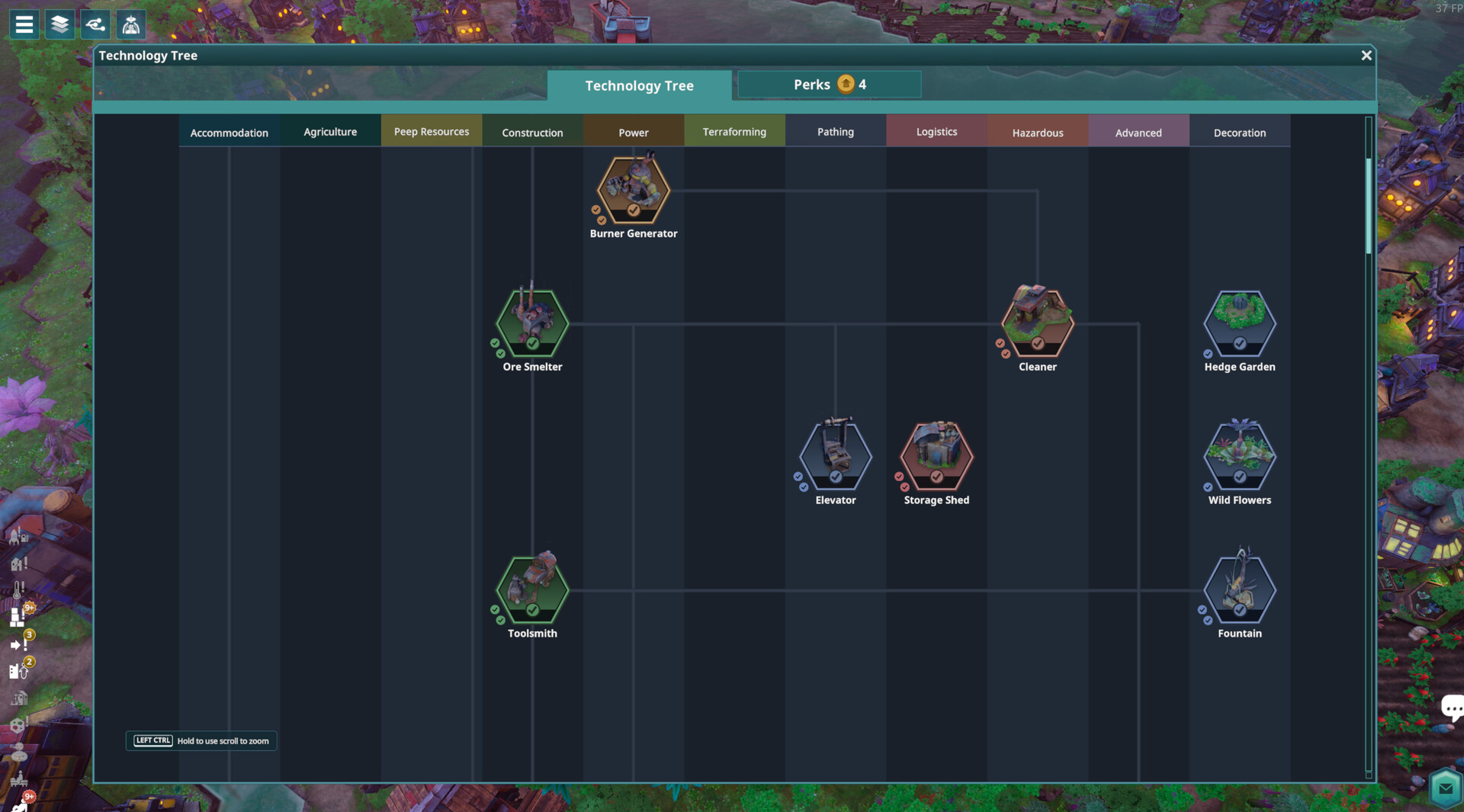
The Mine’s listed products are stone and sand. The Ore Smelter’s listed products are iron with soot, and copper with soot. The Toolsmith lists tool and slag. The Sawmill’s buildings-list product is plank. A Steam screenshot of the technology tree shows the Burner Generator, Ore Smelter, Toolsmith, and Cleaner on the same board, which matches those names on the wiki.
Power
Peeps do not carry power. It moves from generators through touching buildings or through Power Lines. The power article says a generator set to run continuously will keep running as long as it has inputs and its byproduct storage is not full. If the connected grid has no room left for power, the extra power disappears and the generator still consumes inputs.
Early power is the Burner Generator, which the article shows burning wood. Wood stays useful later because it is renewable. The Fuel Generator and Battery Generator make more power per cycle, but their fuels depend on buildings that themselves need power. Solar Panels need no input resource, yet they work only in a system with a star, so the article says they are reliable on settled planets and inconsistent on Kewa.
Before Power Lines exist, early powered buildings such as the Ore Smelter, Toolsmith, and Metal Smelter have to touch one another with no road or gap between them. They do not each have to touch the generator. The Power Line’s own tech prerequisite is the Ore Smelter, the same building that already needs power, so the first powered cluster is a touching group.
Byproducts
The resources table’s byproduct names include soot, slag, sludge, goo, wood waste, and organic waste. The buildings list pairs several of them with a main product: Burner Generator with power and soot, Metal Smelter with steel and slag and with glass and slag, Cement Factory with cement and sludge, Fuel Generator with power and sludge. GameObserver’s pre-release review adds a sawmill example: planks plus wood waste, with the mill stopping when wood waste fills it. The official buildings row lists only plank for the Sawmill, so the wood-waste stoppage stays with that review. The Woodcutter’s wood waste is on the official resources page.
The Compost Heap is the early official use for wood waste: compost, which the Landscaper spreads to make fertile ground. The pollution article’s early use for soot is the Cleaner. A By-Product Yard appears on the buildings list with no tech prerequisite listed. Its intake rules are not stated on that page.
Pollution and toxic ground
The pollution article says working buildings cause pollution, which hurts Kewa and makes Peeps unhappy and sick. Forests slowly reduce pollution nearby, so an early polluter such as the Burner Generator can be placed among several forests to delay the need for a Cleaner. That matters because saplings and Power Lines are not available at the start. Where there is no forest, Cleaners fed with soot are the next defense. Soot comes from early Burner Generators and Ore Smelters. The article says the work may take two or three Cleaners, plus pausing buildings and cycling their tasks.
The article states that 22 buildings pollute, and that construction and power buildings are especially heavy. Examples it publishes, with the level it assigns, include the Mine and Sawmill at low, the Burner Generator and Ore Smelter at medium, the Metal Smelter at high, and the Cement Factory and Fuel Maker at very high. This page stops at those examples. The article text does not support an unambiguous list of all 22 names.
Tiles that stay at highly polluted or very highly polluted for 15 minutes become a toxic area. Peeps will not walk on those tiles, so workplaces inside them shut down. The article says a Toxic Tile Scraper can clean them. Once the settlement produces chemicals, the Cleaner can clean toxic tiles too. Scraper workers step onto toxic ground, become unhappy, and are likely to get sick. The buildings list separately names a Toxic Tile Cleaner. This guide does not treat that name and “Toxic Tile Scraper” as confirmed aliases.
LadiesGamers describes the same failure in play: heavily polluted tiles can turn toxic and stop factories inside them, and the review’s suggested prevention is to build industry nearer forest or to use cleaners. That review also says a depleted mine has to be replaced elsewhere. The official resources page says the opening stone and iron deposits exist near the Home Spaceship. It does not state that every mine runs dry. Depletion is reported as the review’s claim.
Adjacency
Most buildings gain a bonus or a penalty from whatever sits against them. The buildings article says planning can change production speed, storage, work slots, happiness, pollution, and power draw. Early cases it calls out:
- Water Pump: +30 percent storage on an outcropping surrounded by three water tiles.
- Hut: +20 percent happiness next to two Potato Patches.
- Woodcutter: +30 percent storage when forest surrounds it except for the road.
- Burner Generator: −25 percent pollution when four tiles beside it are empty and it is not fully surrounded.
- Early decorations: +20 percent happiness when two other decorations are adjacent, such as a triangle of three.
Roads, bridges, and an Elevator (tech prerequisite: Ore Smelter) are how the settlement crosses uneven ground. The Wooden Bridge lists the Sawmill as its tech prerequisite. LadiesGamers also describes pausing a building or changing its priority so the right good is made and storage does not overflow. Priority matches the wiki’s warning that lower-priority jobs go unstaffed when workers are short.
How this industry changes Kewa’s mood, and when terraforming unlocks, is on the Kewa page. A shorter opening order is on beginner tips.
What is still unknown
Per-cycle input recipes, exact storage caps, and the full set of 22 polluting buildings are not reproduced here because the fetched pages did not support a complete, unambiguous list. Trade prices with alien species are also unpublished in the sources used for this page.