Beginner priorities are water, food, housing, and pollution
The first jobs in Beyond These Stars, according to the official wiki and two pre-release reviews, are a water supply, potatoes, houses, and wood, placed so Peeps can actually reach the work. Industry comes next, and it creates soot and other extras that stop the chain if they pile up. These tips are paraphrased from those published pages.
Advertisement
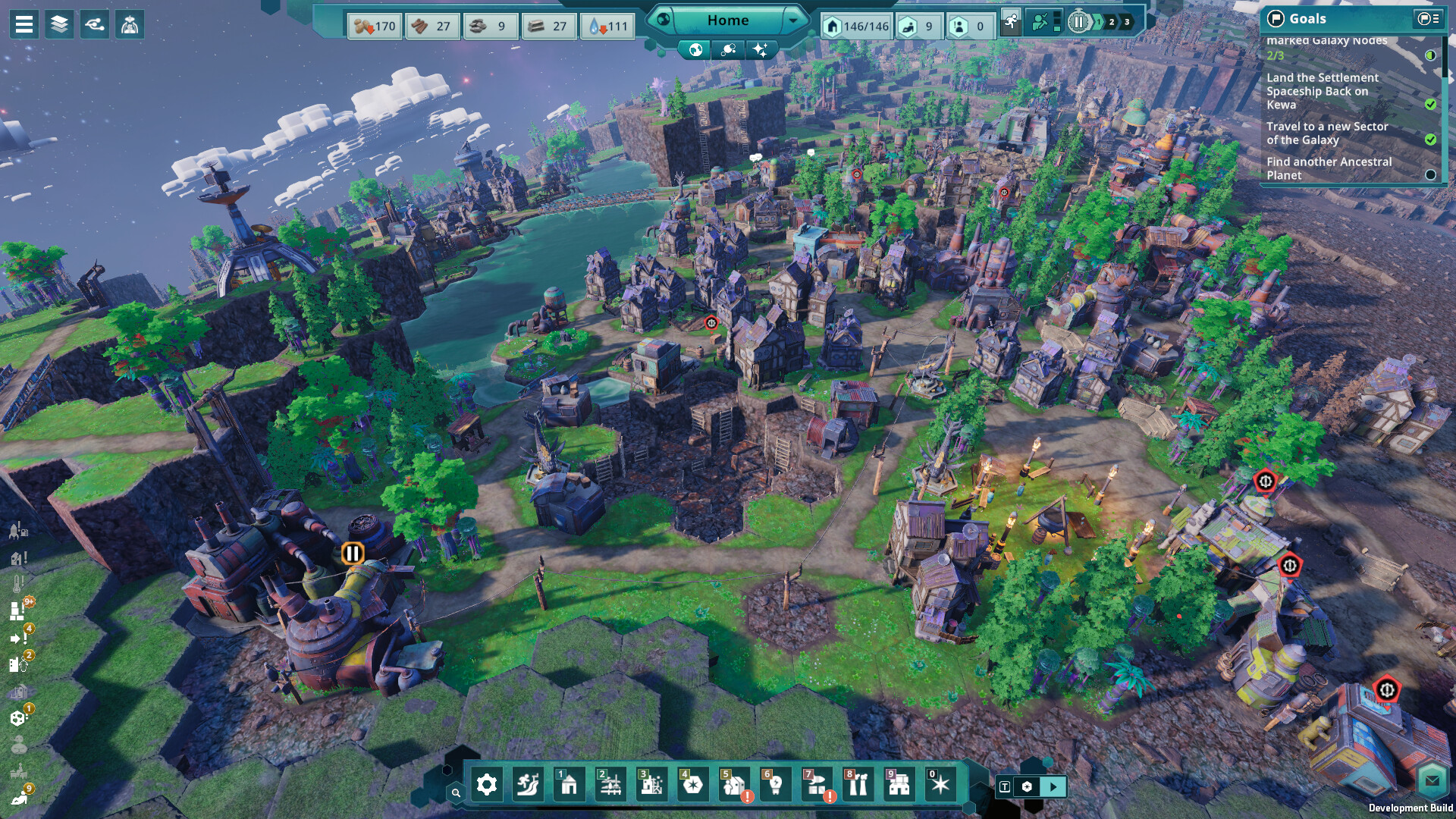
Opening placements
LadiesGamers says the campaign’s first guided steps are water and food, then mining, wood, and basic industry. The official buildings list leaves the tech prerequisite blank for the Hut (4 wood and 4 stone, 2 workers), the Potato Patch (4 wood), the Water Pump (2 wood and 2 iron), and the Woodcutter (2 tools and 6 wood, 1 worker). The resources article says trees, one stone deposit, and one iron deposit are always in range of the Home Spaceship.
The Water Pump’s published adjacency bonus is specific: 30 percent more storage when it sits on an outcropping surrounded by three water tiles. Some buildings must be placed next to water; the pump is the early building whose bonus depends on that. A Hut gains 20 percent happiness when two Potato Patches sit beside it. Those two bonuses are the closest thing the buildings page offers to an opening layout.
Construction finishes only after Peeps deliver the materials. If a building in the chain is paused, the wiki says the wait can continue indefinitely. That is the published reason to unpause the producer before expecting the next building to appear.
The 16-tile job limit
A housed Peep will work at any workplace within 16 tiles of that home, and will not take a job farther away. Fetching and delivering can go outside the radius. The practical result, taken straight from that rule, is that a factory on the far side of the plate does nothing until someone lives within 16 tiles of it. When a building looks understaffed for no resource reason, the published check is the distance to the nearest occupied home.
One shared shift
All Peeps work at the same time, then break at the same time. Extra workplaces do not create a night shift. If jobs outnumber workers, lower-priority buildings can be left idle for the whole shift. LadiesGamers describes changing priority, and pausing buildings, so the good you actually need is the one that gets made and so storage does not overflow.
Breaks only help if the house already holds food and drink. Peeps gather those into the home from nearby buildings, then eat and drink at the start of the break. More valuable food and drink restore more happiness and energy. On the resources table, water and potatoes are the low end of that scale: both list an exhaustion recovery of 0.55, and potato’s happiness recovery is 0. Later foods are listed much higher. For example, the table lists berries at 100 happiness. Decorations restore happiness faster than resting at home, and early decorations gain 20 percent happiness when two others sit against them.
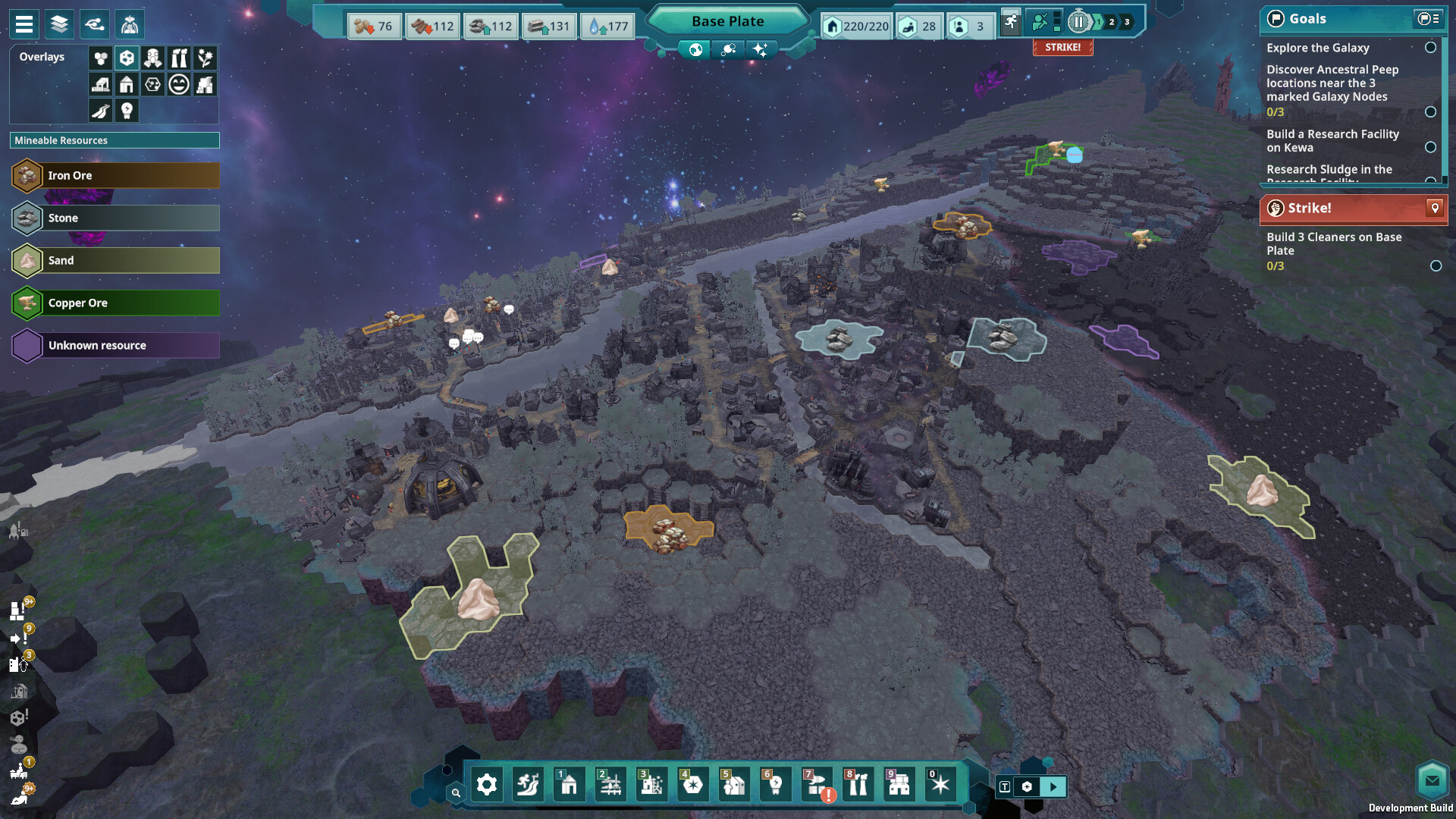
The Peeps article says unmet needs can make Peeps refuse work or make costly mistakes. Both reviews use the word strike. A Steam screenshot titled Base Plate shows a strike notice next to a mineable-resource overlay listing iron ore, stone, sand, copper ore, and an unknown resource. The screenshot is evidence that a strike alert exists in store art. It is not a published formula for exactly when the strike starts.
Pollution before cleaners
The pollution article’s first defense is forest, because forest slowly clears pollution beside it. It specifically suggests putting an early polluter such as the Burner Generator among several forests, so there is time to reach the first Cleaner. The Cleaner needs a continuous supply of soot. Early soot producers named there are the Burner Generator and the Ore Smelter. The article says it may take two or three Cleaners, plus pausing and cycling tasks.
The Burner Generator’s own adjacency note pulls in a different direction: pollution drops 25 percent when four neighboring tiles are empty and the building is not fully surrounded. Forest cover and that empty-tile bonus are both published. The pages used here do not say which arrangement wins when they conflict. They do say forests are the first line of defense before saplings and Power Lines exist.
High or very high pollution that lasts 15 minutes turns the tile toxic. Peeps refuse to walk there, and the workplaces inside stop. That timer is the published reason not to leave a smelter running in a bare patch “just for a little while.”
Power before Power Lines
The Burner Generator does not require power and is the first generator the power article describes. It burns wood. The Ore Smelter, Toolsmith, and Metal Smelter do require power, and they have to touch each other, with no road or gap, until Power Lines are available. They do not each have to touch the generator. The Power Line’s tech prerequisite is the Ore Smelter, so the touching cluster is the setup for the first powered buildings, not an optional tidy-up.
A generator keeps burning inputs even when the grid cannot store more power. The extra power is discarded. Leaving every generator on “continuous” while storage is full is a published way to spend wood and fill soot for no stored power.
Do not fill the waste slot
Woodcutters create wood waste along with wood. Burner Generators create soot along with power. The official condition for a generator to keep running includes “byproduct storage is not full.” GameObserver describes the same stall at a sawmill: when wood waste fills the building, planks stop, and buildings downstream stop with them. The Compost Heap is the early published consumer of wood waste. Cleaners are the early published consumer of soot. Neither is free at minute one. The Compost Heap requires the Landscaper, and the Landscaper requires the Metal Smelter. The Cleaner’s listed tech prerequisite is the Chemical Factory.
Until those buildings exist, the published tools are placement (forests around early polluters), pausing, and priority. LadiesGamers also warns that unwanted byproducts clog industry and can collapse a save, which matches the stall the wiki describes.
Terraforming and travel
Terraforming is how the plate grows after basic industry exists. Batch landscaping tiles into one job. Dig channels beside water, then finish the job to release the water. Compost bare ground with wood waste. Plant saplings to push the breathable edge outward. One forest’s atmosphere reaches four tiles, and only watered forest produces it. The full tool list is on the Kewa page.
Travel is a later project. The Strange Transmitter, which is how Peeps request a destination, requires the Electronics Plant. Kewa can refuse and detour to eat. Solar Panels, which need no fuel, are described as reliable on a planet in a star system and inconsistent on the whale. Outposts and the lack of named alien factions are on the galaxy page.
Steam lists “save anytime.” GameObserver reported four freezes during conversations with Kewa in a pre-release build and used older saves to get past them. That is one reviewer’s experience of one version. It is not a confirmation that the release build still freezes, and this site has no patch note that says the bug was closed.
What these tips do not claim
No exact strike threshold, no perfect city blueprint, and no “always build three cleaners” rule are stated here. A store screenshot shows a goal about cleaners; the pollution article says two or three may be needed, which is not the same as a fixed quota. Difficulty options exist on Steam, and the effect of each option is unknown. Controller support is unknown.